Why I Stopped Building AI StudyMate
为什么我停止开发 AI StudyMate
A classroom project about learning continuity led me to design an AI tutor—and discover that trusted knowledge was the hardest part to build.
一个关于学习连续性的课堂项目,让我开始设计 AI Tutor,也让我发现:最难构建的并不是 AI,而是可信知识。
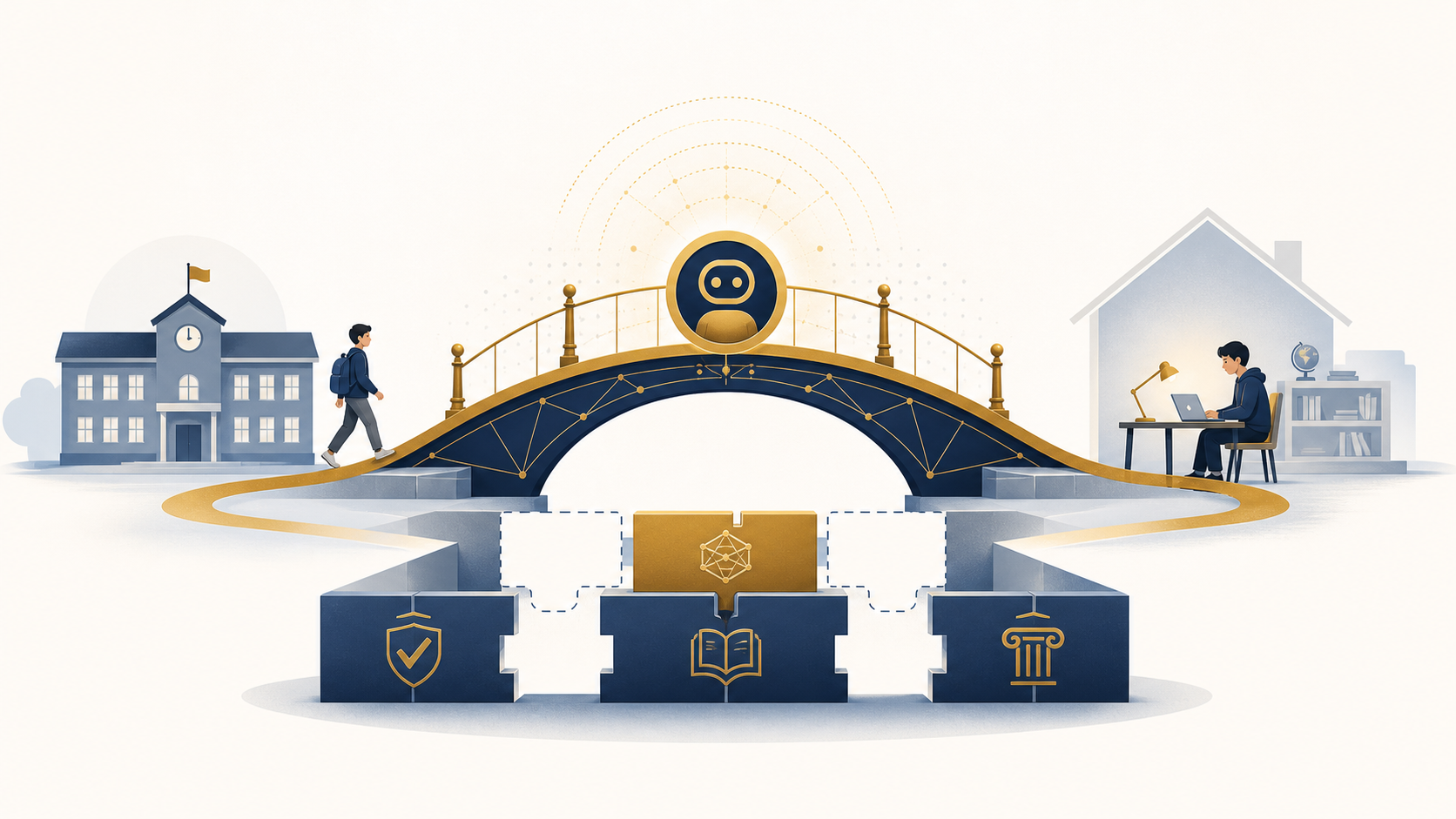
AI StudyMate began as a classroom project, but the question behind it had been with me for much longer: why do we treat learning as a sequence of measurable outcomes when real learning is continuous, uneven, and deeply personal?
We expect every class to produce visible progress and every student to move at a comparable pace. But learning is closer to exercising or growing. Practice can happen every day without improvement becoming visible every day. Returning to an idea is not failure; sometimes it is how understanding becomes durable.
The continuity gap
A student may receive structured instruction during school, but that support often disappears after the student leaves the classroom. A difficult concept follows the student home. Confusion grows in the hours before help becomes available again. Repeated often enough, a temporary knowledge gap can turn into frustration, avoidance, and eventually disengagement.
Many students do not fail loudly. They disengage quietly.
I wanted to explore whether AI could support this unstructured space between classrooms. Not by replacing schools or teachers, automating education, or optimizing only for test scores. The intended role was narrower: AI StudyMate would be infrastructure for learning continuity.
From generating answers to understanding learning
Large language models are good at producing answers. But an answer tells us very little about how a person learns. A meaningful learning system should notice where understanding breaks, which prerequisite may be missing, what kind of explanation helps, whether a learner persists, and whether the same friction returns later.
The idea was to move attention away from ranking students only by final outcomes and toward understanding their learning interactions. Students would receive explanations and next steps. Parents could see confidence and continuity signals. Teachers could see class-level patterns. Curriculum reviewers could see where material repeatedly failed to support understanding.
The feedback loop was meant to support students—not surveil them.
The product I imagined
The original architecture had four layers, all serving one goal: sustained learning.
A central design principle separated canonical content from adaptive content. Canonical content defined what was correct: the concept, prerequisites, learning objective, solution method, answer, and assessment criteria. Adaptive content changed how it was presented: language, examples, hints, pace, sequence, and review frequency.
An AI could explain ratios through volleyball, cooking, games, or shopping. It should not invent a different definition of a ratio for every learner.
The foundation I thought RAG would provide
At the design stage, retrieval-augmented generation appeared to solve the problem of consistency. Build a trusted curriculum knowledge base, retrieve the right source, add student context, and let the LLM personalize the presentation. The generated answer could remain flexible because the academic foundation would remain controlled and traceable.
But when I moved beyond the presentation and considered implementation, the assumed foundation became the central problem.
When the trusted knowledge does not exist
The system needed a corpus that was academically reliable, sufficiently complete, structured by grade and learning sequence, appropriate for student instruction, and legally reusable for storage, retrieval, transformation, and AI-assisted delivery.
Public learning standards exist, but standards are not a curriculum. They describe what students should learn without necessarily providing a teaching sequence, worked examples, practice sets, answer keys, rubrics, remediation strategies, or age-appropriate explanations.
Commercial textbooks and learning platforms contain much of this missing structure, but they are protected by copyright and licensing restrictions. The ability to read or purchase a textbook does not automatically include permission to ingest it into a database, transform it through an AI system, or redistribute its content to students.
Why AI-generated curriculum was not the answer
The obvious workaround was to ask an LLM to generate the missing lessons, examples, questions, hints, and answer explanations. But that would reverse the architecture. The original design used trusted knowledge to constrain generation. If the model generated the knowledge base itself, the system would be grounding AI output in other AI-generated output.
Human review could reduce this risk, but reviewing a full curriculum is not a lightweight quality check. It requires subject experts, instructional designers, grade-level alignment, version control, governance, and continuous maintenance. At that point, the project is no longer simply an AI tutor. It is a curriculum institution.
Why I stopped
I did not stop because the learning problem was unimportant, or because AI had no role in education. I stopped because the part I had treated as an input—trusted curriculum—was actually the largest product, governance, and rights problem in the system.
A prototype could still look convincing. It could produce polished explanations and personalized examples. But without a reliable and authorized knowledge foundation, that polish would hide the most important uncertainty instead of resolving it. In education, especially for children, a plausible answer is not an adequate standard.
Stopping was not a rejection of the idea. It was a decision to respect what the idea required.
What the project taught me
AI StudyMate changed how I evaluate AI products. I now look for the hidden dependency behind the demo: Where does the knowledge come from? Who is authorized to use it? Who defines correctness? Who reviews it? How is it updated? What happens when the source is incomplete or contested?
The intelligence layer is often the most visible part of an AI product. But the knowledge, rights, and governance layers may determine whether it deserves to exist.
AI can make knowledge adaptive. It cannot, by itself, make knowledge trustworthy.
AI StudyMate 最初是一个课堂项目,但它背后的问题,我其实已经观察了很久:真实的学习明明是连续、曲折而且高度个体化的,我们为什么总把它当成一连串可以立刻衡量的结果?
我们期待每一节课都产生看得见的进步,也期待不同学生以相近的速度前进。但学习更像锻炼和成长。练习每天都在发生,进步却未必每天都显现。重新回到一个概念并不意味着失败;有时候,这正是理解变得牢固的方式。
学习连续性的缺口
学生在学校里可以获得结构化的教学支持,但离开课堂后,这种支持往往突然中断。一个没有理解的概念被带回家,困惑在下一次能够获得帮助之前不断累积。当这种情况反复发生,暂时的知识缺口就可能变成挫败、逃避,最后变成脱离学习。
很多学生并不会明显地“失败”,他们只是安静地退出了。
我想探索,AI 是否可以支持课堂之间那段缺乏结构的时间。它不是为了替代学校或老师,不是为了自动化教育,也不是只为提高考试分数。它的角色应该更克制:AI StudyMate 是学习连续性的基础设施。
从生成答案,到理解学习过程
大语言模型很擅长生成答案,但一个答案并不能说明一个人是如何学习的。真正有意义的学习系统,应该能够识别理解在哪里中断、哪个前置概念可能缺失、什么样的解释真正有效、学生是否愿意继续,以及同样的摩擦是否再次出现。
我希望把注意力从“只用最终结果给学生排名”,转向理解他们与知识互动的过程。学生得到解释和下一步建议;家长看到信心与连续性的信号;老师看到班级层面的学习模式;课程设计者看到哪些内容反复阻碍理解。
这个反馈循环应该用来支持学生,而不是监控学生。
我最初设想的产品
最初的架构有四层,它们共同服务于一个目标:让学习可以持续。
其中一个核心原则,是把“标准内容”和“适配内容”分开。标准内容定义什么是正确的:概念、前置知识、学习目标、解题方法、答案和评价标准。适配内容只改变知识如何被呈现:语言、例子、提示、节奏、顺序与复习频率。
AI 可以用排球、烹饪、游戏或购物来解释比例,但它不应该为每个学生发明一个不同的“比例”定义。
我原以为 RAG 能提供的基础
在设计阶段,检索增强生成看起来能够解决一致性问题:建立一个可信的课程知识库,检索正确来源,加入学生语境,再让大语言模型调整呈现方式。生成内容可以灵活,而学术基础依然受控、可追溯。
但当我离开演示文稿,真正开始考虑实现时,这个被默认存在的基础,反而成了整个项目最核心的问题。
当可信知识并不存在
这个系统需要一套在学术上可靠、内容足够完整、按年级和学习顺序组织、适合学生使用,并且在存储、检索、转换和 AI 辅助交付上都获得合法授权的知识库。
公开的学习标准确实存在,但标准并不是课程。它能说明学生应该学什么,却未必提供完整的教学顺序、例题、练习、答案、评分标准、补救策略和适龄的讲解语言。
商业教材和课程平台包含许多缺失的结构,但它们通常受到版权与许可限制。能够阅读或购买一本教材,并不自动意味着可以把它录入数据库、通过 AI 转换,再分发给其他学生。
为什么 AI 生成课程也不是答案
最直接的替代方案,是让大语言模型生成缺失的课程、例子、问题、提示和答案解释。但这会把最初的架构倒置。原本的设计是用可信知识约束生成;如果知识库本身也由模型生成,系统就变成了用 AI 生成的内容去“验证”另一层 AI 生成的内容。
人工审核可以降低风险,但审核一套完整课程并不是轻量的质量检查。它需要学科专家、教学设计、年级对齐、版本控制、治理和持续维护。到这一步,项目已经不再只是一个 AI Tutor,而是在建设一家课程机构。
为什么我选择停止
我停止开发,并不是因为这个学习问题不重要,也不是因为 AI 在教育中没有位置。我停下来,是因为那个曾被我当作“输入”的可信课程,其实才是系统里最大的产品、治理与权利问题。
一个原型仍然可以看起来非常有说服力。它可以生成流畅的解释和个性化的例子。但如果没有可靠且获得授权的知识基础,这种流畅只是在遮蔽最重要的不确定性,而不是解决它。在教育里,特别是面对儿童时,“听起来合理”不能成为足够高的标准。
停止并不是对这个想法的否定,而是尊重这个想法真正需要的条件。
这个项目教会了我什么
AI StudyMate 改变了我判断 AI 产品的方式。现在,我会去寻找演示背后隐藏的依赖:知识从哪里来?谁有权使用?谁定义正确?谁来审核?如何更新?当来源不完整或存在争议时,系统该怎么办?
智能层往往是 AI 产品最显眼的部分,但知识、权利和治理,才可能决定这个产品是否值得存在。
AI 可以让知识变得更有适应性,但它无法仅凭自己让知识变得可信。